Sofia Coppola – Auteur Analysis
QUT, Introduction to Screen Studies, 2026
Film Analysis · Auteur Theory · Academic Writing · Cultural Analysis
For this assignment, I wrote a 1200-word auteur analysis arguing that Sofia Coppola constructs female interiority through cinematography across The Virgin Suicides (1999), Lost in Translation (2003), and Marie Antoinette (2006). Written for Introduction to Screen Studies at QUT, 2026, employing Andrew Sarris's auteur theory as an analytical frame.
Sofia Coppola: Constructing Female Interiority through Cinematography
Sofia Coppola is an established auteur whose distinct visual language has remained consistent across her body of work. Her films represent her lens of the female experience, reinterpreting themes of nostalgia, loneliness, self-reflection and adolescence through an immersive and dream-like state. In her book, Archive, Sofia states, “Across all of my films, there is a common quality: there is always a world, and there is always a girl trying to navigate it. That’s the story that will always intrigue me.”(Coppola, 2023) Andrew Sarris’s auteur theory states that a director’s personal vision should be resonant in the way their films look and move, and that technical competence, a distinguishable personality, and interior meaning together define a true auteur. As scholar N. Monaghan notes, Coppola “has always had a deep feeling for young people, and for women whose problems seem small but cut right to the heart of what humans want out of life” (2023, p.99). Through her films, The Virgin Suicides (1999), Lost in Translation (2003) and Marie Antoinette (2006), this essay argues that Coppola constructs her female protagonists’ interior lives through cinematography, utilizing intimate framing, soft available light and the use of both static and handheld observational cameras that reveal her characters’ emotional worlds.
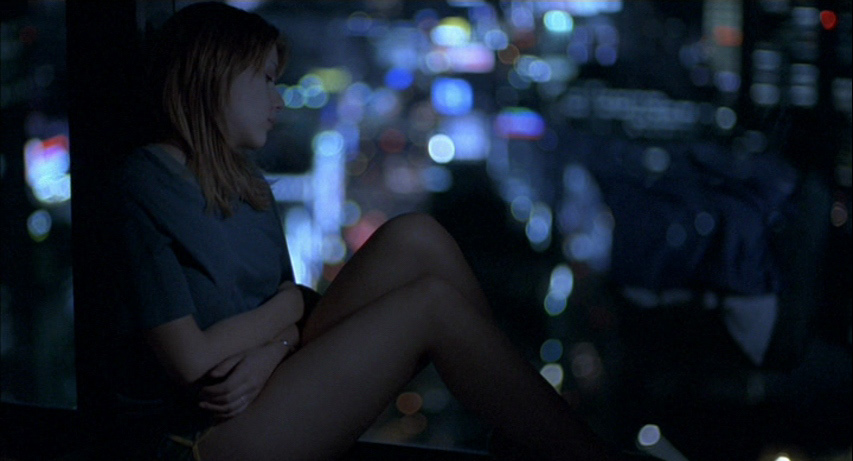
Still frame from Lost In Translation (dir. Sofia Coppola, 2003)
Technical Competence
In Lost in Translation (Coppola, 2003), Charlotte sits contemplatively in the window of her hotel room – her knees tucked to her chest as she takes in the Tokyo skyline. Cinematographer Lance Acord aimed to convey the actor’s emotional state by using a subjective approach to the camera’s point of view, “keeping it as much with the characters as possible”. (Staff, 2004) The hand-held camera pans the cityscape slowly, with a slight, intimate shake, and it utilizes a wide depth of field. As the frame lands on a close-up of Charlotte, her back to the lens as the camera decisively pans around her, the frame slowly shifts to a shallow depth of field. Her introspective gaze is revealed for a beat before returning to a wide depth of field of her vast surroundings, removing her from the frame and highlighting her emotional disconnect from her environment. Acord notes, “Part of the way to obtain intimacy is to keep the overall scale of the production down.” (State, 2024) For her first feature, The Virgin Suicides (Coppola, 1999), cinematographer Edward Lachmann helped establish what would come to be Coppola’s signature aesthetic through natural available lighting that utilizes warm lens flares, saturated tones, and golden highlights. (View of Permanence and Transience in Sofia Coppola’s “The Virgin Suicides,” 2012) In a scene set inside the Lisbon house, rebellious sister Lux is framed in the right corner of the room, her body partially cut outside of the frame, while the camera slowly pans to her sisters playing together in the middle of the room, establishing her aloofness. A static, medium close-up of Lux, from a high-level frame, observes her from inside, using a shallow depth of field, drawing attention to the character’s introspection. In a scene from her stylized retelling of Marie Antoinette (Coppola, 2006), a voiceover narrates a letter addressed to Antoinette, who is framed in a medium long-shot, standing against opulent floral wallpaper. As the letter’s contents are read aloud, with distressed body language, she begins sliding herself down the wall as a zoom-shot slowly frames her in a medium close-up. This slow zoom adds emphasis to Marie’s distress, contrasting with her ornate costuming and baroque environment – lit by soft and pastel lighting. This consistent cinematographic approach across three of Coppola’s most respected films demonstrates the technical competence Sarris identifies as innate to auteur filmmaking.
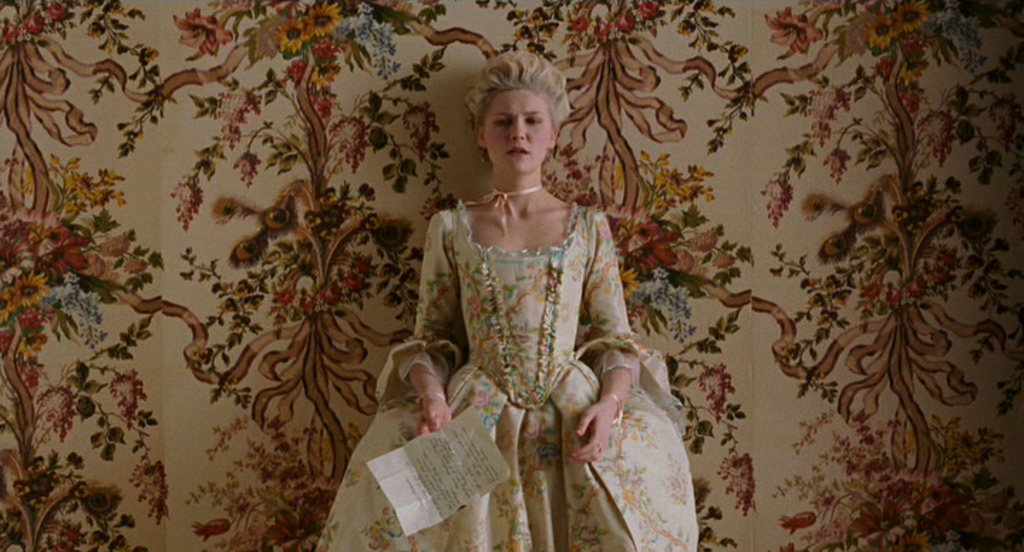
Still frame from Marie Antoinette (dir. Sofia Coppola, 2006)
Distinguishing Personality
Smaill (2011) identifies Coppola’s directorial signature through her “narrative emphasis on girlhood and a feminine, ethereal tone,” noting her films’ consistent use of composition and image texture to invoke emotion – most often expressed through alienation and displacement. Coppola’s recurrent portrayal of women at pivotal points in their lives, characteristics of nostalgia and emphasis on visual storytelling support Sarris’s second premise of the auteur theory – the distinguishable personality of the director as a criterion of value. Her work exhibits “certain recurrent characteristics of style,” marking her signature as an auteur (Sarris, 2007). In Lost in Translation (Coppola, 2003), Charlotte’s loneliness is depicted through intimate framing and vast atmosphere, balancing character and environment without reliance on dialogue. In The Virgin Suicides (Coppola, 1999), a close-up of Lux’s hand dipping into a toy aquarium establishes internal longing and unrest. In Marie Antoinette (Coppola, 2006), the dressing scene uses handheld and observational camera work to place the viewer inside an intimate moment, where Marie is laughing and discussing fan and shoe designs. The unease of Marie’s political status is portrayed through her avoidance of the topic and supported by the set and costume design. Not only do these films demonstrate Coppola’s auteur status through their shared themes and visual language, but also through her recurring collaborations, as actress Kirsten Dunst plays the protagonist in both The Virgin Suicides (Coppola, 1999) and Marie Antoinette (Coppola, 2006), reinforcing the personal creative vision central to auteur theory. (Gaut & Livingston, 2003, p.106)
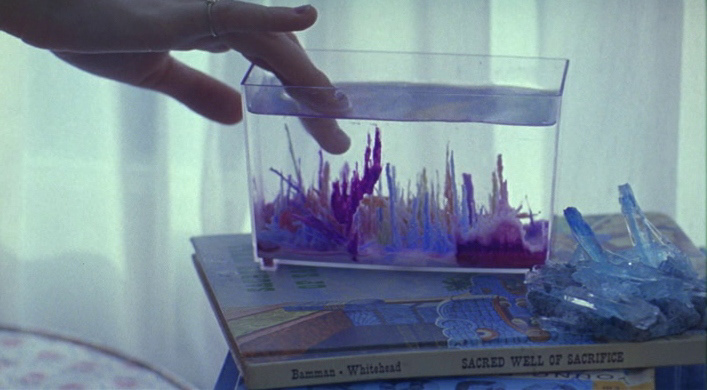
Still frame from The Virgin Suicides (dir. Sofia Coppola, 1999)
Interior Meaning
Critics have argued that Coppola’s emphasis on visual style and mood substitutes its possibility for deeper meaning, positioning her as a metteur en scène rather than a true auteur – a director who executes aesthetics without a cohesive interior meaning (Smaill, 2011). Andrews (2013) states that auteur theory has been broadly critiqued for promoting individual creative vision while overlooking systemic inequalities within the film industry, particularly regarding women and minorities. However, these underestimate the interior meaning in Coppola’s craft. As Sarris' theory suggests, interior meaning can be found in the hesitation between beats, within the quiet moments that carry weight precisely because they refuse explanation. In Lost in Translation (Coppola, 2003), Charlotte’s emotional state is communicated entirely through composition and stillness. In The Virgin Suicides (Coppola, 1999), a time-lapse of the house lights flickering off and Lux’s fingers drifting through a toy aquarium conveys confinement and longing without a word spoken. In Marie Antoinette (Coppola, 2006), Marie slides down a wall while a voice-over narration of a letter is read, her distress implied through body language, facial expression and staging. In none of these scenes do the protagonists articulate their inner states. Meaning is felt through controlled performance and detailed mise-en-scène. Coppola’s subtle approach to portraying heavy emotions represents a consistent, recognizable worldview of an auteur who understands that silence and stillness can say more than action.
Sofia Coppola’s body of work demonstrates the three criteria central to Sarris’s auteur theory. Her consistent cinematographic choices reflect technical competence through deliberate control of her visual language. Her distinguishable personality is evident across The Virgin Suicides (Coppola, 1999), Lost in Translation (Coppola, 2003), and Marie Antoinette (Coppola, 2006) – each film returns to the same recurring motif of young women navigating inner lives within constraining environments. Most significantly, Coppola’s interior meaning resides in her restraint. As Sarris notes, interior meaning can exist in the smallest hesitation within a film’s rhythm. (Sarris, 2007, p. 402) Coppola’s directorial decisions are built on these hesitations. Her films inhabit an innate sense of feminine inner world, marking her a true auteur in contemporary cinema.