

Princess Mononoke – Ecocinema Analysis
QUT, Introduction to Screen Studies, 2026
Film Analysis · Reflective Essay · Academic Writing · Cultural Analysis
For this assignment, I wrote a 1700-word reflective essay arguing that Miyazaki employs ecological critique through mise-en-scène and genre conventions in Princess Mononoke (1997), signifying environmental collapse through its narrative and worldbuilding, using Graeme Turner's Film as a Social Practice as an analytical frame.
Pain, Hatred and Ecological Destruction in Princess Mononoke

Still frame from Princess Mononoke (dir. Miyazaki, 1997)
Princess Mononoke (1997), written and directed by Hayao Miyazaki and animated by Studio Ghibli, is a fantasy-adventure ‘jidaigeki’ (Japanese historical drama), set during the late Muromachi period, a time marked by a pre-industrial feudal society in Japan. The film carries a powerful message of environmental justice through a narrative of war, depicting the conflict between townspeople and the mystical forest gods. As a work of ecocinema, defined by Willoquet-Maricondi as film with consciousness-raising activist intentions oriented toward awareness of planetary wellbeing and humanity's relationship with the earth (Willoquet-Maricondi, as cited in Rust et al., 2012, p. 44), Princess Mononoke uses worldbuilding and narrative to advocate for environmentalism and interrogate the effects of urban industrialisation. Chu (2016, p. 12) further suggests that ecocinema raises the question of how effectively film encourages viewers to think and act ecocritically, – a question Princess Mononoke answers through its refusal to offer easy resolutions. The film's release, during Japan's Lost Decade, which was a period of significant economic downturn and financial crisis (Fukao, 2003), positions it as a cultural indicator of its time that retains its relevance today (Turner & Duckham, 2006). Viewing this film through Graeme Turner's Film as Social Practice, this essay examines Princess Mononoke as a cultural product that reflects social anxieties about industrialisation and humanity's fractured relationship with the natural world. Princess Mononoke profoundly shifted my ecological awareness through its cinematic form, marking it as a definitive work of ecocinema, which I personally define as cultural criticism underlined by the intent to shine light on ecological injustices.
The world of Princess Mononoke is divided between Irontown and the mythical forest. Two environments that are at war as a direct result of human exploitation and industrialisation. Miyazaki constructs this conflict through mise-en-scène and detailed worldbuilding: the forest is rendered in vibrant, high-contrast colour, with lush greenery, towering trees, and deep blue water that together evoke a world that feels alive and almost sacred. Irontown contrasts this through a dark and muted palette of browns, the air thick with smog from the mass production of firearms, and a dirt-covered ground stripped of any organic life. Turner (2006, p. 68) notes that filmed images carry both denotative and connotative meaning – that beyond what an image literally depicts, camera angle, lighting, colour, and framing all carry social meaning shaped by cultural experience. The brown palette of Irontown connotes moral and ecological exhaustion, while the forest's vibrant greens and deep blues imply life untouched by humans. The town's vast walls, which I felt functioned less as protection and more as a declaration of separation from nature, made the human world feel deliberately sealed off from the environment it was consuming. Frames filled with workers carrying spears and firearms under Lady Eboshi's rule made the town feel hostile and mechanical to me. The colourless, pollution-filled environment is depicted as monotonous and exhausting.
In the shot moments before the cursed boar-god attacks young prince Ashitaka, the village can be seen from a wide-angle shot as a chunk of land within the forest, stripped of trees and grass, now filled with huts and dirt. The entire frame is covered in greenery except for the emerging civilisation in the middle, which lacks colour and life – directly positioning the surrounding forest as a resource for humans to exploit. In a forest shot, the Forest Spirit is seen illuminated by glowing sun rays, in a full shot between two giant tree-trunks covered in flower blossoms, suggesting that life flourishes in a world untouched by humans. This shot resonated with me directly; its stillness and soft light made the forest feel sacred, which made the threat of its destruction feel personal rather than theoretical. Watching the townspeople exploit and hunt the forest gods made the film's ecological critique feel uncomfortably close to reality. Ecologist Adrian Ivakhiv, as discussed in Ecocinema Theory and Practice (Rust et al., 2012), proposes a holistic method of engaging with cinema across the material, the social, and the perceptual – a framework that captures how I experienced this worldbuilding as someone whose privileges only exist because of industrialisation, leaving me with a conflicted, saddened response that offers no clear resolution. Miyazaki's ecological message is clear through the distinct differences between the two environments; I believe it could have been enhanced by depicting the town's water as murky or undrinkable and the forest's water as increasingly depleted, extending the visual language of human destruction into the water systems to make the environmental impact even more visceral.
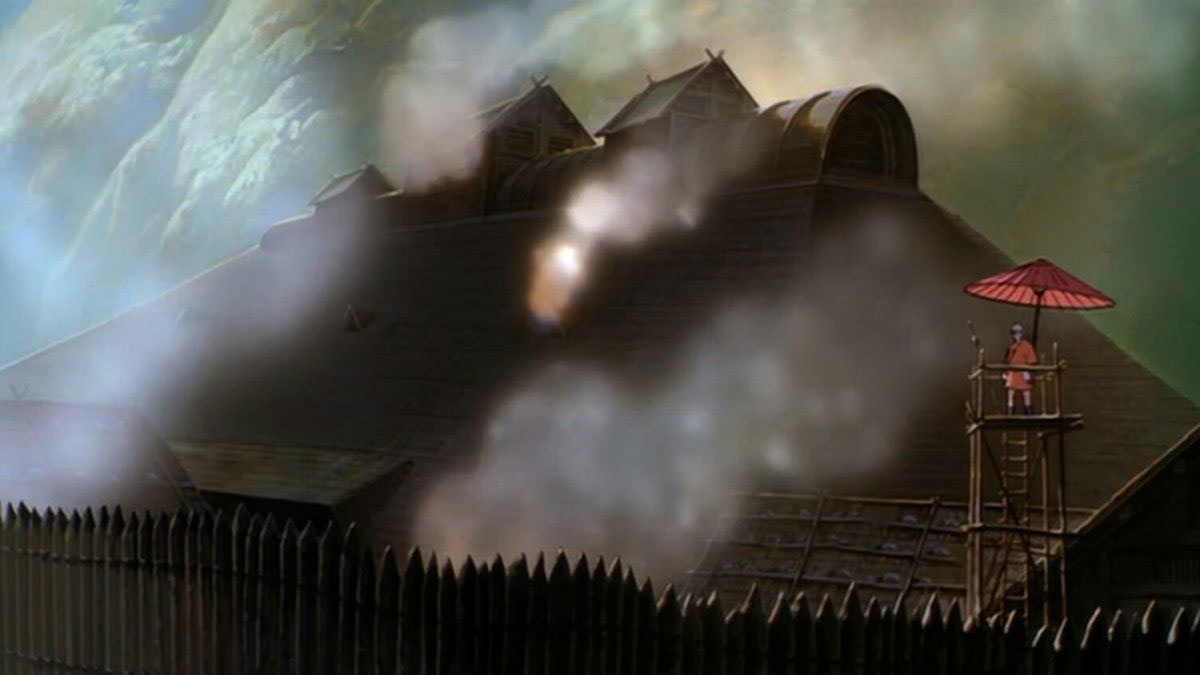
Irontown
Still frame from Princess Mononoke (dir. Miyazaki, 1997)
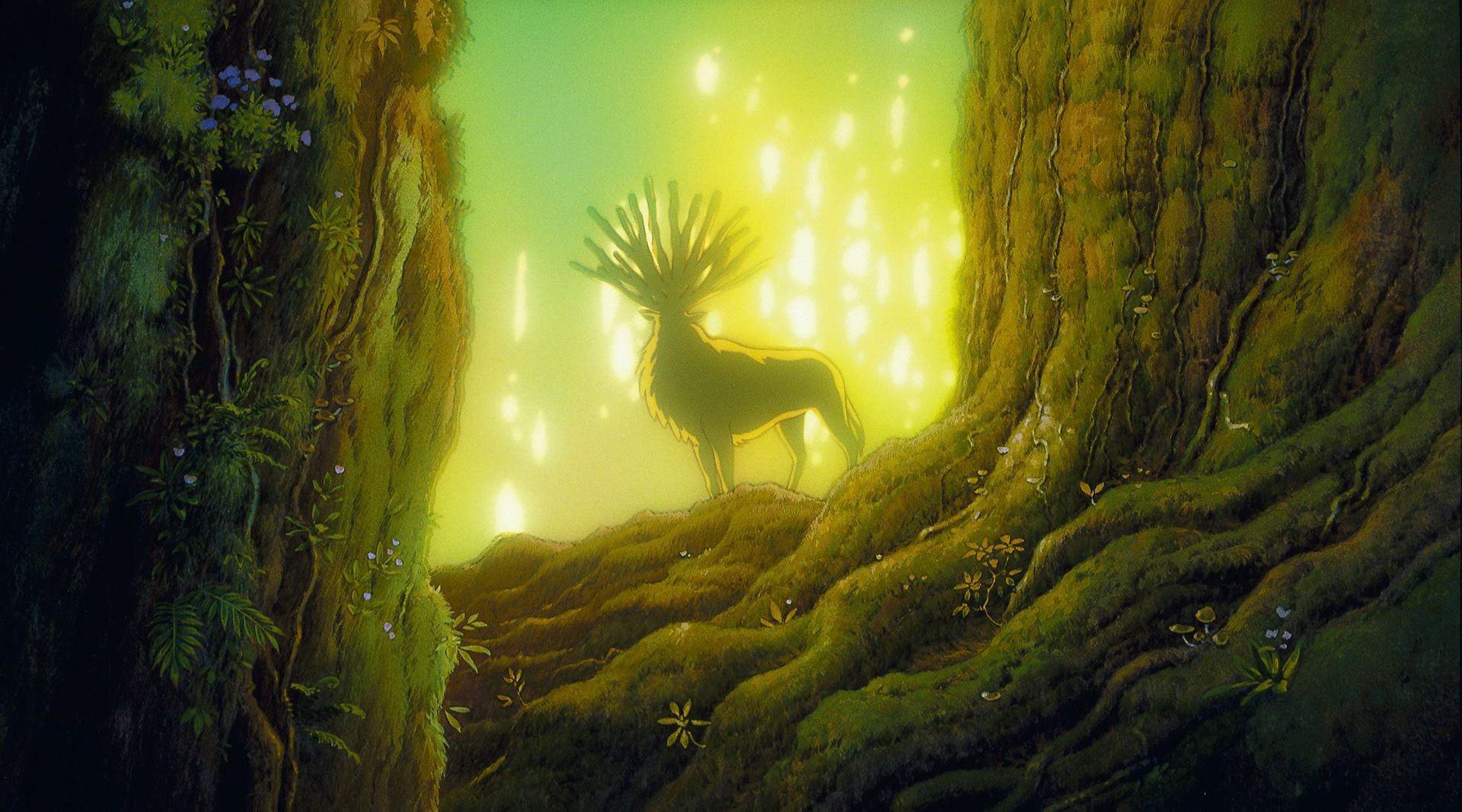
Mythical Forest
Still frame from Princess Mononoke (dir. Miyazaki, 1997)
Miyazaki's use of the fantasy genre is central to how Princess Mononoke delivers its ecological message. Rather than conveying environmental destruction through documentary-style observation, Miyazaki uses the conventions of fantasy, using gods, spirits, and mythic corruption to make ecological collapse feel profound and spiritually consequential. Rust et al. (2012, p. 6) suggest that cinematic representations of the natural world are shaped as much by culture, politics, and economics as by the nonhuman world itself, and that ecocinema troubles the assumptions of the so-called nature film by reminding us that the borders between human and nonhuman worlds are fluid. Princess Mononoke exists within this fluidity. Its fantasy conventions dissolve the boundary between human and natural, making ecological destruction feel like a shared devastation. This indirect approach, I felt, made the film's environmental argument impossible to intellectualise away, because the destruction of nature is not framed as an economic or political problem, but as a moral failure with earnest spiritual weight.
In the sequence depicting the death of the Forest Spirit, Lady Eboshi raises her rifle and shoots the Forest Spirit in the face, and the single act of brutality triggers the total environmental collapse of the forest. A dark, swirling mass of particles erupts from the Spirit's body, rapidly expanding to consume the entire forest. The animation of this spreading darkness is deliberately organic and formless, echoing the way pollution infiltrates every available space without warning. The kodama begin falling silently from the branches, their descent signalling the forest's loss of life at its most elemental level. This moment was heartbreaking. The kodama had existed throughout the film as quiet indicators of ecological health, and watching them fall felt less like a fantasy event and more like a depiction of species extinction – gradual, and largely unnoticed. As the sequence escalates, the Forest Spirit's headless body evolves into a massive entity larger than the forest itself, its darkness consuming everything as the humans flee. The Spirit, once framed intimately as a serene deer-like figure between blossomed trees, is now an uncontrollable force of destruction triggered entirely by human action. As Ashitaka swims through the contaminated water carrying the injured Lady Eboshi, and San confronts him in grief and fury, the sequence refuses a clean moral position, because the destruction is total and no character escapes it unaffected. Drawing on Turner's framework in Film as Social Practice, this sequence reads as a direct cultural response to Japan's Lost Decade. As an auteur with complete creative control, Miyazaki's environmentalist perspective feels rooted in genuine frustration. His decision to work through fantasy rather than realism makes the consequences of treating nature as a resource feel emotionally resonant rather than abstract. The emotional distance built through adventure conventions was dismantled by this shift, leaving me with no comfortable position to watch from.

Falling Kodama
Princess Mononoke (dir. Miyazaki, 1997)
"Young man, like you I know what rage feels like, and grief and helplessness... Life is suffering. It is hard. The world is cursed, but still you find reasons to keep living" (Miyazaki, 1997). This moment of quiet counsel is rooted in the scene that humanises Lady Eboshi, where we learn that she houses society's outcasts: women and people living with leprosy, giving them purpose and protection that feudal society denied them. This is the film's most uncomfortable piece of cultural commentary, because the antagonist's actions are rooted in genuine human care that directly conflicts with the environment. The desperation conveyed through the workers' bandaged hands and wrapped heads suggested people with no alternative, which shifted something in how I viewed the ecological destruction. To a significant extent, this scene moved my awareness further than any other. It reframed human destruction of the environment as desperation carried out by people who had no other way to survive rather than sole ignorance. Using Turner's framework, this scene functions as a direct critique of the ideology that positions industrialisation as straightforwardly evil. The dim lighting and close framing stripped any heroism from the act of production, leaving only exhaustion. I felt implicated in a way I hadn't anticipated; as someone who benefits from industrial production daily, the distance between observer and participant collapsed entirely. What the film is really about, underneath the gods and the guns, is hatred. It depicts humans destroying what they fear, fearing what they cannot control, consuming what they cannot own. Osa's words reframe destruction as a condition: rage, grief, and helplessness. In today’s modern landscape, where climate debates reduce to opposing sides driven by fear and economic desperation, this reading feels uncomfortably current. The forest is worth saving, but so are the people inside the walls. The film does not tell you how to hold both truths at once, and neither does reality, which leaves me with a feeling of ambivalence towards the problem of industrialisation.
Princess Mononoke profoundly shifted my ecological awareness, because it refused to present environmentalism as a clear moral position. Through Miyazaki's mise-en-scène and worldbuilding, the visual contrast between Irontown and the forest constructed an ecological argument I felt before I properly understood. Through the fantasy genre and his auteurist refusal of clean resolution, the Forest Spirit death sequence made environmental collapse feel spiritually consequential rather than politically abstract. And through the rifle manufacturing scene, depth and complications revealed that destruction is rarely carried out by people with uncomplicated motives. Viewing Princess Mononoke through Film as Social Practice changed how I understand film as a cultural product, because the cinematic choices directly reflect and interrogate surfacing social anxieties that often remain unspoken. I did not expect an animated fantasy film to make me question a moral dilemma between ecological destruction and humanity, but in the end it did – and I now have a more nuanced understanding of how ecocinema uses the complexity of human experience, rather than simple moral judgment, to make its ecological argument land.
References
Chu, K. (2016). Ecocinema. Journal of Chinese Cinemas, 10(1), 11–14. https://doi.org/10.1080/17508061.2016.1142728
Fukao, M. (2003). Japan's lost decade and its financial system. The World Economy, 26(1), 365–384. https://doi.org/10.1111/1467-9701.00527
Ivakhiv, A. (2012). Toward a multicultural ecology. In S. Rust, S. Monani, & S. Cubitt (Eds.), Ecocinema theory and practice (pp. 78–94). Routledge.
Miyazaki, H. (Director). (1997). Princess Mononoke [Film]. Studio Ghibli.
Rust, S., Monani, S., & Cubitt, S. (Eds.). (2012). Ecocinema theory and practice. Routledge.
Turner, G., & Duckham, M. F. (2006). Film as social practice. Taylor & Francis Group. https://ebookcentral.proquest.com/lib/qut/detail.action?docID=995662