Ex Machina – Mise-en-Scène Analysis
QUT, Introduction to Screen Studies, 2026
Film Analysis · Textual Analysis · Academic Writing
For this assignment, I wrote a 700-word textual analysis of a single scene from Alex Garland's Ex Machina, examining how set design, character blocking, and cinematography establish the film's central power dynamic between its three characters.
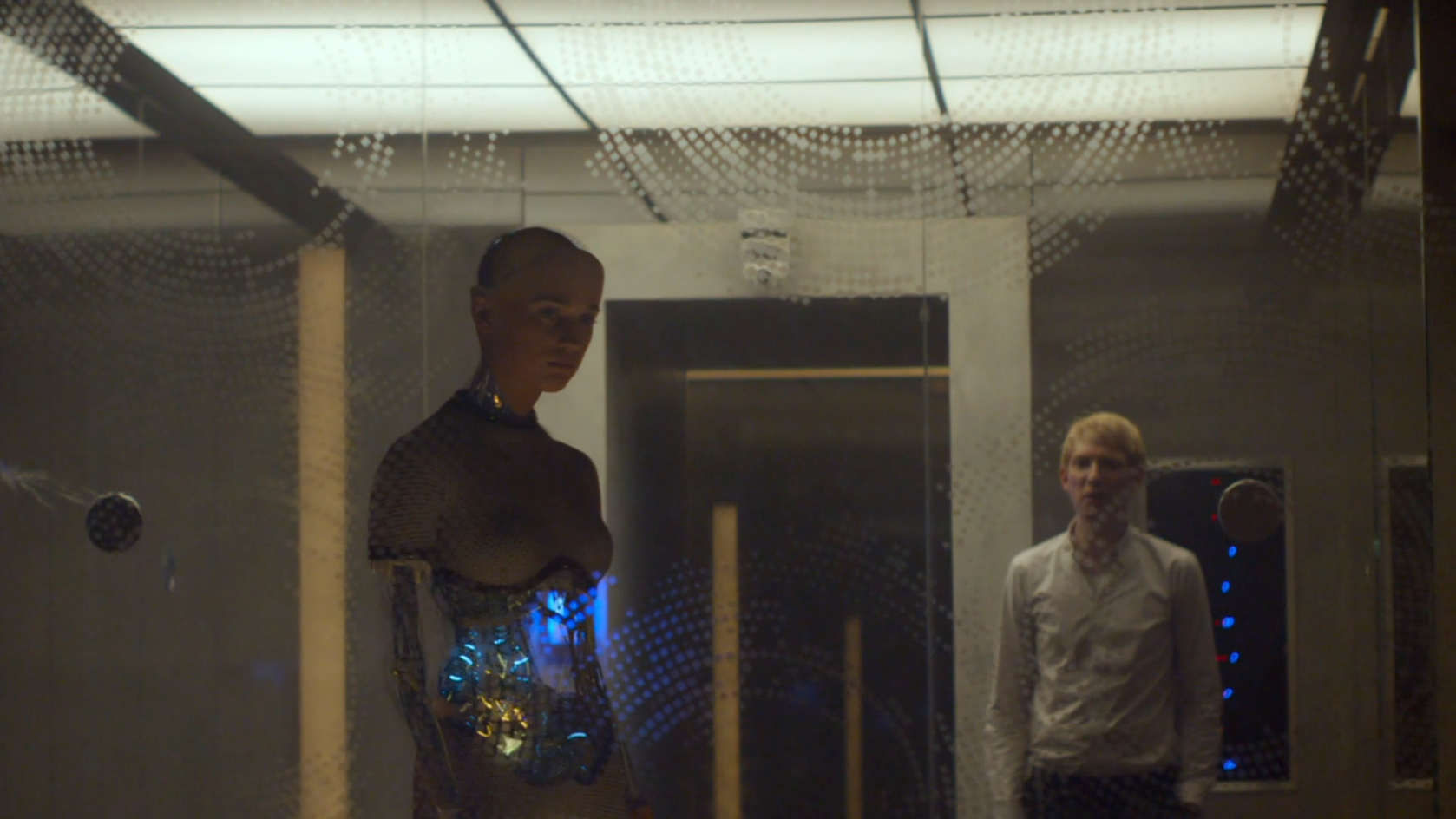
Still frame from Ex Machina (dir. Alex Garland, 2024)
Ex Machina, written and directed by Alex Garland, is a science-fiction thriller rooted in psychological tension and intense power dynamics. The set design and character blocking play a crucial role in establishing the film’s narrative, which yields themes of power, control, and the ethics of Artificial Intelligence. When Caleb first meets humanoid robot Ava, the juxtaposition is distinct: human/AI, freedom/confinement, man/woman, all enhanced through the visual elements of the set and the character's physical distance. The scene takes place inside Ava’s enclosure, a room within Nathan’s brutalist-style mansion, set deep within a secluded rural forest.
This cool-toned, expressionistic room matches the polished, sharp architectural style throughout the house, with concrete walls and high ceilings that feel commanding and inescapable. With a predominantly grey palette, the “colour of intellect and emotional disconnect” (Centre of Excellence, n.d.), supports Nathan’s cold technological authority and Ava’s emotional disconnect and isolation from the world beyond her enclosure. The tall archway in the middle background is visually significant, with a white security camera adhered directly above the frame. This camera establishes Nathan's dominance and power over both Ava and Caleb, framed centrally above and between them. A thick panelled glass wall separates the two characters, embossed with round geometric dots that align with this modernized digital environment. Two round speakers are seen on the glass, adding a parallel element that draws attention to Ava and Caleb's similarities, lacking authority. A black control panel emitting blue light is on the wall behind Caleb, inaccessible to Ava. It also contrasts with the blue light emitting from her mechanical body, reinforcing her status as a piece of technology. Every element of the space is controlled by Nathan. The overhead panelled ceiling light is impersonal, exposing and imposing. Glass is used to thematically signify both Ava’s isolation and transparency, mirroring the openness which develops between the two characters across the film’s narrative. The camera's placement behind the glass positions the audience to observe this dynamic, creating distance and objectivity.
Ava is positioned on a visual interest point using the rule of thirds, where she occupies the left foreground of the frame. She has a stronger presence in this still, contrasting her powerlessness in her literal confinement. Her body is angled away from Caleb with rounded shoulders and a downward gaze. This withdrawn, closed-off posture suggests her caution and uncertainty in the situation. Since she has only ever known Nathan’s controlling presence, her body language is communicating uncertainty about whether Caleb can be trusted. Her face is melancholic and contemplative; she appears to be aloof, furthering this disconnect between the AI and human experience. In the background, Caleb appears significantly smaller on the right side of the frame, the low angle of the camera contrasting with his attentive and open body language. With upright posture, his body faces Ava, where he is looking directly at her, clearly trying to engage. By positioning Caleb to appear small beside the tall, commanding door frame, which Nathan observes from the security camera, he is seen as equally powerless. The security camera is positioned centrally in the background between the two of them. This blocking signifies the central tension of power with Ava’s uncertainty and Caleb's naivety in the scene, where they are both being watched by Nathan. Additionally, this still foreshadows the film's ending, where Ava turns her back on Caleb as he watches her walk away through the glass door.
Through minimal and meticulous set design and contrasting character blocking, the cerebral tone of Ex Machina is established and reinforced. This aligns with Nathan's affluent, controlling presence, a man whose environment is an extension of his authority. Production designer Mark Digby described the space as built around concrete and glass, noting it mirrors "how man-made elements frame a fantastic natural environment" and how Ava's mechanics frame her inner intelligence (Set Decorators Society of America, 2015). Garland's unconventional directorial style favours psychological restraint, and his work consistently injects "existential numbness into genre conventions" (Doherty, 2025). This directly contrasts with the tendency of contemporary science-fiction films to push creative boundaries and innovate in set design (Archdaily, 2023). Here, the decision-making is deliberate and restrained, reflecting the film's narrative and underlying suspense.